
With the changing world around us by the transforming technology, the divide between human perception and artificial intelligence is closing very rapidly. The recent introduction of the American Psychological Association (APA) of new principles of ethical use of AI in psychology is a concern that directly relates to our practice, relationship and care of clients.
Being a licensed psychologist in India I have been placing much thought on what it implies to my clients all over the world, and where the therapy itself is going.
The meaning of the APA Ethical AI Guidance.
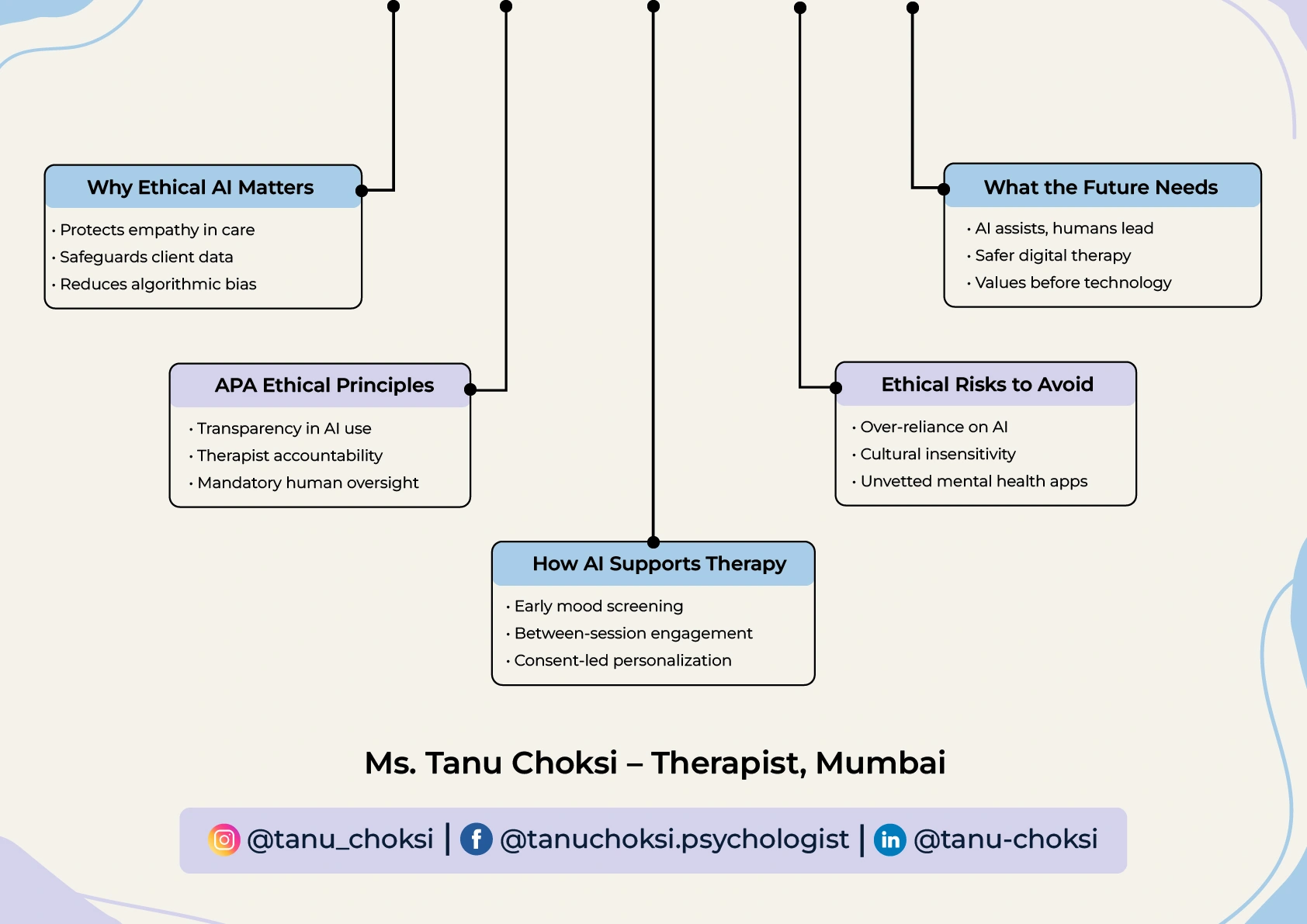
The new framework released by APA is aimed at the responsible ways in which psychologists must incorporate the concept of AI into clinical practice.
In simple terms, it asks:
- What should we do to employ AI and not to lose empathy?
- What security will be required to ensure client privacy?
- What is the possible way to use data without having prejudices?
Such are not mere hypothetical questions. To most therapists in Mumbai or the globe at large, AI-based tools, such as chatbots and mental-health apps, are already becoming part of the automated routine. With this direction we have a guide on how to negotiate that changing space.
The importance of Ethical AI in Therapy.
The field of wellness has been penetrated by AI in a short period of time — screening apps, emotional recognition, and even initial checkups are not a new trend. Mental health support needs to be more accessible but technology should not water down human connection.
- Protecting Confidentiality
The APA is focused on data privacy. Information that is gathered with the help of AI about a client should be safe, encrypted and this information should not be disseminated without their agreement. - Preserving Human Judgment
AI may facilitate diagnosis, but not clinical decision-making. Ethical use involves being able to determine the boundaries that technology has and above all professional responsibility. - Promoting Equity
Algorithms are biased by the information that they are trained on. The new guidelines advocate constant review to allow the marginalized voices not to be distorted or neglected.
The main tenets in the APA Framework.
The following is a simplified perspective of the key pillars in the application of ethical AI in psychology:
- Transparency – Clients must understand when AI is used in their care.
- Accountability – Psychologists are held to account and not technology.
- Knowledge – Before using AI systems, professionals have to know how they operate.
- Non-maleficence – Do no damage, make sure the tools used are validated, and culturally sensitive.
- Human Oversight – All AI-advice must be checked by a licensed therapist.
These concepts serve to remind us that convenience is not the reason why technology should be adopted, but compassion.
Implementing AI in Practice.
In my personal practice of providing online psychologist consultation in India not only in India but also worldwide, I apply digital tools in a wise manner:
- Assessment Support – The AI questionnaires will be able to identify mood changes at a young age.
- Session Preparation – Data aids me to make sessions more personal and still remain confidential.
- Constant Checking – Apps enable clients to monitor between the sessions in case of emotions and habits.
All tools are considered and discussed with the clients ethically and are discussed clearly to clients before use, as consent generates trust.
Common Ethical Pitfalls
The closest professionals are known to fall prey to cross-boundary confusion. I’ve seen challenges such as:
- Too much use of AI interpretations.
- Overlooking cultural or linguistic differences in international customers.
- Free online tools are used without reading the data policies.
To prevent such pitfalls, I belong to a simple rule that Technology can help therapy, but not replace the therapist.
The Future of AI and Therapy
Everything will be fine if the future is handled thoughtfully. Early-stage warning of mental-health decline may soon be aided by AI which can then be used to intervene in time. However, compassion, confidentiality, and culture will never be substituted.
To clients seeking online psychologist consultation in India, it indicates that they can more easily have care which is backed by research and ethics and not automation per se.
Ethics Educate Building Letters.
In case you are taking and would like a support via AI in your mental-health process, or you do not know whether you should use digital devices in therapy, want to discuss. As an Indian and a skilled psychologist, my mission is to assist the client in making a wise decision and ensuring their emotional and cyber security.
Technology: Technologies are a great friend, and yet it has to be driven by morality and compassion.
Conclusion
APA guidelines on ethical AI scare us out of complacency about the fact that progress and principles should go hand in hand. I am a licensed psychologist in India and, therefore, I do not consider AI as a threat; on the contrary, I see it as an opportunity to make therapy even smarter and more accessible and at the same time remain deeply human.
It is not much but very deep: do not be afraid to innovate and do not lose integrity as a therapist. Learn, reflect, and heal — follow Tanu Choksi on Instagram, LinkedIn, and Facebook for expert insights on therapy and self-understanding.