
Introduction
Lately I have been witnessing the increased controversy concerning the banning of books – as a therapist and a teacher in my core, I find this issue distressing. Books are not only stories, they are windows, mirrors, and bridges that form our empathies.
Living as a licensed psychologist in India, I have observed the cruelty of being exposed to multiple ideas to form abiding emotional strength, self-expression, and compassion. In this work, I would like to think about the purpose of book bans on our minds – and why defending intellectual freedom is an emotionally daring thing to do.
Understanding Book Bans
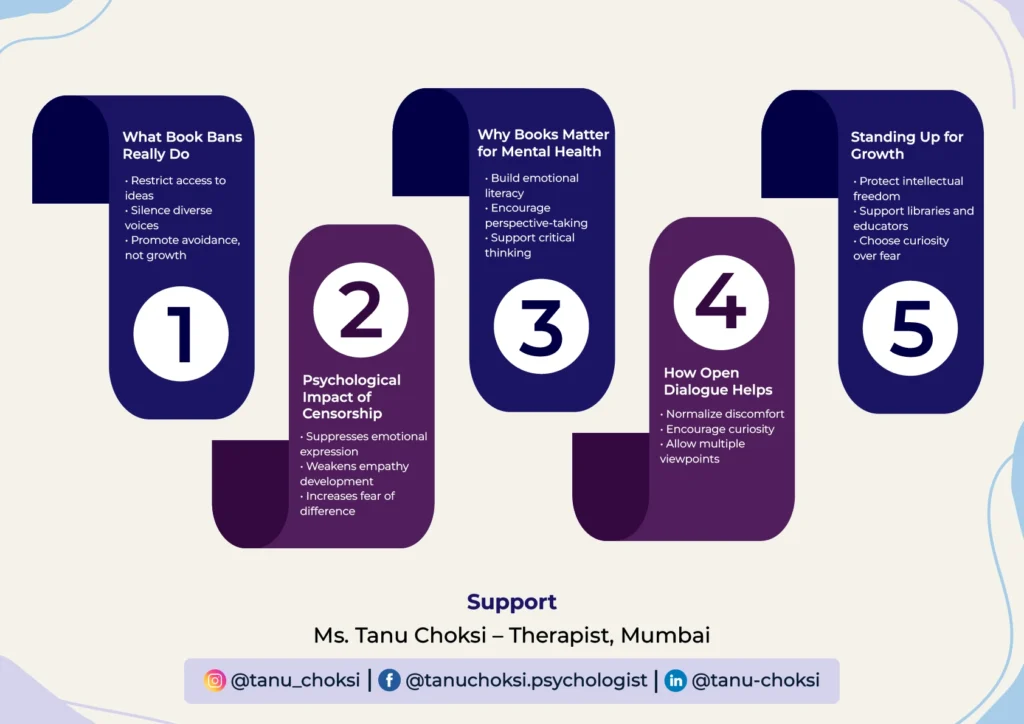
Book bans are instances in which institutions such as schools, libraries, or governments disregard or censor access to books based on the material, subject, or concept in the books.
Although it is typically stated as the necessity to protect readers, the issue of bans is most often motivated by anxiety about the diversity – of ideas, identity, experience.
Psychologically, this is avoidance coping extreme: the urge to eliminate that which presents a challenge to us instead of tackling it. Avoidance, however, never results in growth; it can only result in repression.
Open dialogue is vital to the healing of therapists such as me, as well as other psychologists in India. Suppressing discourse makes matters even more scary and misconceived.
Why Prohibiting Books Is Hurting Brains
- It Represses Expression of Emotions
Literature can oftentimes provide names to feelings that people are yet to identify. When these books are lost, so is a line of the most important of our self-realization. - It Weakens Empathy
Stories allow us to experience life a thousand times. Bans decrease our ability to learn about different views since they eliminate them. - It Cultivates Fears of Difference
Silencing of some voices makes a reader (and children particularly) understand that difference is something to be scared of – when it is rather what makes people creative and connected.

That is what I see in my clients who have a problem with anxiety or shame. The process of growth is initiated by facing what is unpleasant and not hiding.
Emotional Literacy Main Tenets
All individual therapists know that emotional processing capability is determined by exposure to diverse human experiences. Books are safe ways of developing that exposure.
The following are the psychological aspects that reading fosters:
- Perspective-taking – Getting acquainted with the thoughts or feelings of other people.
- Critical thinking – The ability to judge sophisticated concepts without perceptions.
- Emotional control – Sometimes dealing with responses to painful stories or facts.
These skills form an important part of therapy which teaches the client to loosen up in real life; that is what censorship shuns.
How to Foster Open Dialogue
As I would work with parents or teachers, I would encourage them not to be scared of discussing controversial material, but be curious instead. The following is the practice of that process:
- Accept the Fact of the Uncomfort – Be able to communicate about that which is uncomfortable.
- Discover Meaning – Ask, What does this story mean?
- Promote Critical Discussion – Provide room for various opinions without criticism.
- Model Tolerance – Demonstrate that division does not necessarily mean disagreement.
This can be applied to Group Therapy Sessions in Mumbai where alternate group experiences make a more colourful and kind conversation.
Debunking Myths Around Book Bans
- “They protect children.”
The truth of the matter is that children require learning to think as opposed to being told what to think. - “Controversial issues are destructive.”
The harm is more harmful than being aware; silence is more stigmatizing. - “Books are political.”
Books are human. They represent the multi-faceted aspect of life, whose meaning can only be described in human terms.
What Is The Psychological Cost of Censorship?
Censorship does not just give writers silence – it educates readers in self-censorship. Through time, it constrains imagination, critical thinking, and emotional flexibility.
I have experienced in my practice as a therapist that repressed expression is usually re-expressed in the form of anxiety, guilt, or perfectionism. The process of healing starts when individuals open up to feel and express themselves – and there is no better way of accomplishing this than what literature can achieve more than any classroom lecture.
Taking a Stand for Growth
The defense of books is not merely a cultural problem but a psychological one. By securing ideas, we secure the freedom of feeling, inquiring, and developing.
Regardless of our different schools, workplaces, or personal circles, we can all depict curiosity instead of censorship. Even minor things, such as:
- Suggesting different readings.
- Taking part in the discussion.
- Advocating for libraries.
All these have ripple effects that impact generations.
Conclusion
Emotional freedom is important – as I am an expert therapist in Mumbai and I believe that both healing and growth require emotional freedom. Banning books can help hush down stories; however, it cannot hush down human curiosity.
It is our role as readers, educators, and citizens to ensure that we establish and maintain that attention to wonder. Since every story we save is a step towards knowing ourselves and one another.Learn, reflect, and heal – follow Tanu Choksi on Instagram, LinkedIn, and Facebook for expert insights on therapy and self-understanding.