
Being a therapist, I observe how toddlers watch reels and teenagers scroll late at night almost every day. The use of social media has already entered the lives of children silently and unconsciously. As a parent, many parents have been visiting me because they are concerned about what they are observing, such as a shorter attention span, abrupt emotional outbursts, lack of concentration, among various others, but they may not know the source of the problem.
This is not a trivial discussion since screens are becoming the main substitutes to actual playing, talking, and emoting. What I would discuss in this blog then, is how social media impacts on the cognitive development of children, what science says, and how parents can react to this with the appropriate support systems.
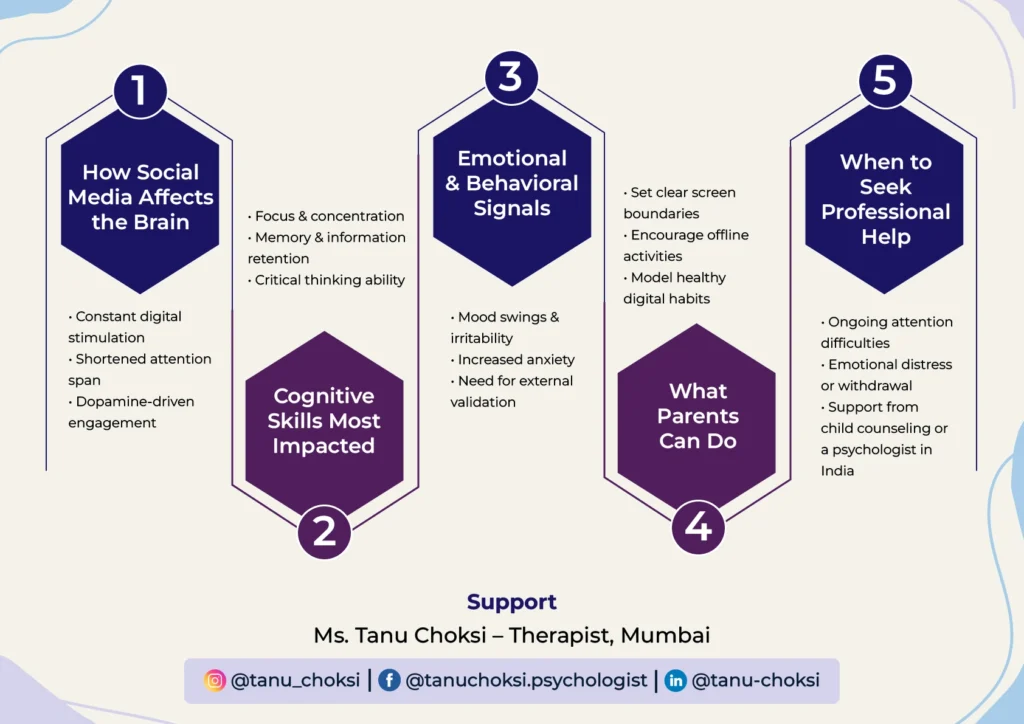
Understanding Social Media and Cognitive Development
By cognitive development, I mean how children learn to think, reason, remember, focus, and ensure that they control their emotions. It is possible that I have noticed during my clinical experience that the majority of social media systems are designed in a way that the brain is constantly active – a tendency that is not always associated with healthy brain development.
On a more basic level, I perceive that social media has an effect on cognition in the form of:
- Constant digital distractions
- Short-form, fast-paced content
- Emotional validation through likes and comments
- Information overload and unrealistic social comparisons
To the minds of young people, such an environment may transform the way information is handled, the manner in which feelings are managed as well as the way self-esteem is seen.
Why This Matters to Parents and Caregivers
Concentration and Learning Capabilities
During my work, I frequently encounter children who are strongly addicted to social media and cannot maintain concentration. Activities which demand profound thinking like reading, learning or problem-solving become increasingly challenging. Through time, the brain is used to stimulation quickly than working long hours.
Emotional Regulation
I frequently meet adolescents who experience anxiety, irritability, and mood swings linked to online comparison and validation. Regular exposure to curated lifestyles and approval systems can quietly shape how children evaluate themselves.
Memory and Information Retention
Quickly moving material makes the brain learn to skim as opposed to comprehending. I observe that this influences long term retention and understanding especially in academic learning.
Social and Communication Skills
As children face the substitution of real world interaction with the digital one, they can become conflicted with respect to empathy, social clues, and conflict handling. It is at this point that early child counseling plays a very important role in the detection and correction of cognitive and emotional imbalances.
Primary Cognitive Domains Affected
Attention Span
The short videos make the brain develop the habit of expecting novelty at all times. With time, I observe that children are no longer tolerant of slower and more effort-based learning.
Critical Thinking
Algorithms restrict the access to different perspectives. This is capable of decreasing independent thoughts and problem solving skills.
Emotional Intelligence
Children can start depending on external validation rather than acquiring the skills of the internal emotional control.
Sleep and Brain Recovery
Exposure to late-night screens interferes with the sleep patterns which are crucial to the development of the brain and memory. This has a direct influence on learning and emotional stability.
All these spheres affect academic results and emotional health.
How Social Media Influence Develops Over Time
Initial Exposure
Children tend to start using social media in a casual way, either to have entertainment or social interaction.

Habit Formation
The frequent repetition of behavior strengthens the dopamine-mediated engagement patterns, which makes it hard to disengage.
Cognitive Shifts
Over time, learning styles and emotional responses adapt to fast-paced digital stimulation.
Behavioral Signals
Parents often report irritability, withdrawal, or lack of focus – signs I frequently observe during therapy sessions.
Intervention Phase
At this stage, support from a Licensed psychologist in India or structured child counseling helps reshape thinking patterns and emotional responses. Early intervention, in my experience, has a high success rate.
Common Parenting Missteps and Healthier Alternatives
A misconception that I can often meet is that all time on the screen is equally bad. Technology is not the problem, but uncontrolled and emotion-based use of technology.
The other common error is the application of strict prohibitions as opposed to controlled limits. Sudden limitations may augment covertness and opposition.
Academics are also another aspect that the parents would choose to concentrate on, ignoring the emotional distress. Cognitive stress is usually initially emotional.
Healthier approaches include:
- Setting consistent boundaries
- Encouraging offline activities
- Modeling balanced screen habits
- Seeking professional guidance when needed
Emerging Trends and Practical Insights
I am seeing growing awareness around digital mental health among families and schools. Online depression and anxiety tests in India are increasingly used as early screening tools to assess emotional strain linked to social media use.
Schools are working with mental health practitioners to implement digital literacy programs, and emotional resilience programs. Much of my practice as a psychologist in India, along with that of many others, is a combination of cognitive-behavioral techniques and digital habit coaching to assist children in becoming refocused, restored in confidence, and in their emotional state.
When Should Parents Seek Professional Help?
In case you observe constant attention problems, emotional instability, school failure, or withdrawal, I highly suggest that you seek the services of a child counseling specialist. They can avoid emotional difficulties in the long run through early assessment.
Conclusion
The use of social media is not naturally negative, but exposure to it without any regulation may lead to serious consequences for children in terms of cognitive development. Digital habits influence attention, memory, emotional control, and learning styles.
Awakening, healthy boundaries, and prompt child counseling are some of the ways through which parents can support and protect the growing brain of their child. A visit to a Licensed psychologist in India and the application of relevant screening tools can enable families to react promptly, in a caring and productive manner, enabling children to become emotionally strong members of the digital community.
FAQs
Is the cognitive development of children harmed by social media irreversibly?
No, most of the cognitive effects can be reversed with early intervention, healthy routines, and professional child counseling. The brain is flexible, particularly in the childhood and adolescent stages of life.
To what extent is social media safe among children?
One cannot say a specific number, but moderation is important. The content quality, schedule, and emotional appeal are more crucial than hours spent on the screen.
When must I visit a psychologist on behalf of my child?
You should consider a meeting with a psychologist in India in case you observe constant anxiety, attention disorders, emotional breakdowns, or withdrawal.
Is online mental testing effective for children?
Credible online depression and anxiety tests in India can be good screening tools, but should in no way substitute professional evaluation.
Is child counseling useful with screen addiction?
Yes. The counseling applied to children takes care of the behavioral patterns and the deeper needs of the child to ensure that a child recovers his/her concentration, builds self-esteem, and has control.