Have you ever used cannabis and later noticed that your thoughts seemed slower, you struggled to remember something you had just discussed, or it took longer to respond to a question?
These experiences can raise an uncomfortable question: Does cannabis actually slow your thinking, or does it only make you feel different?
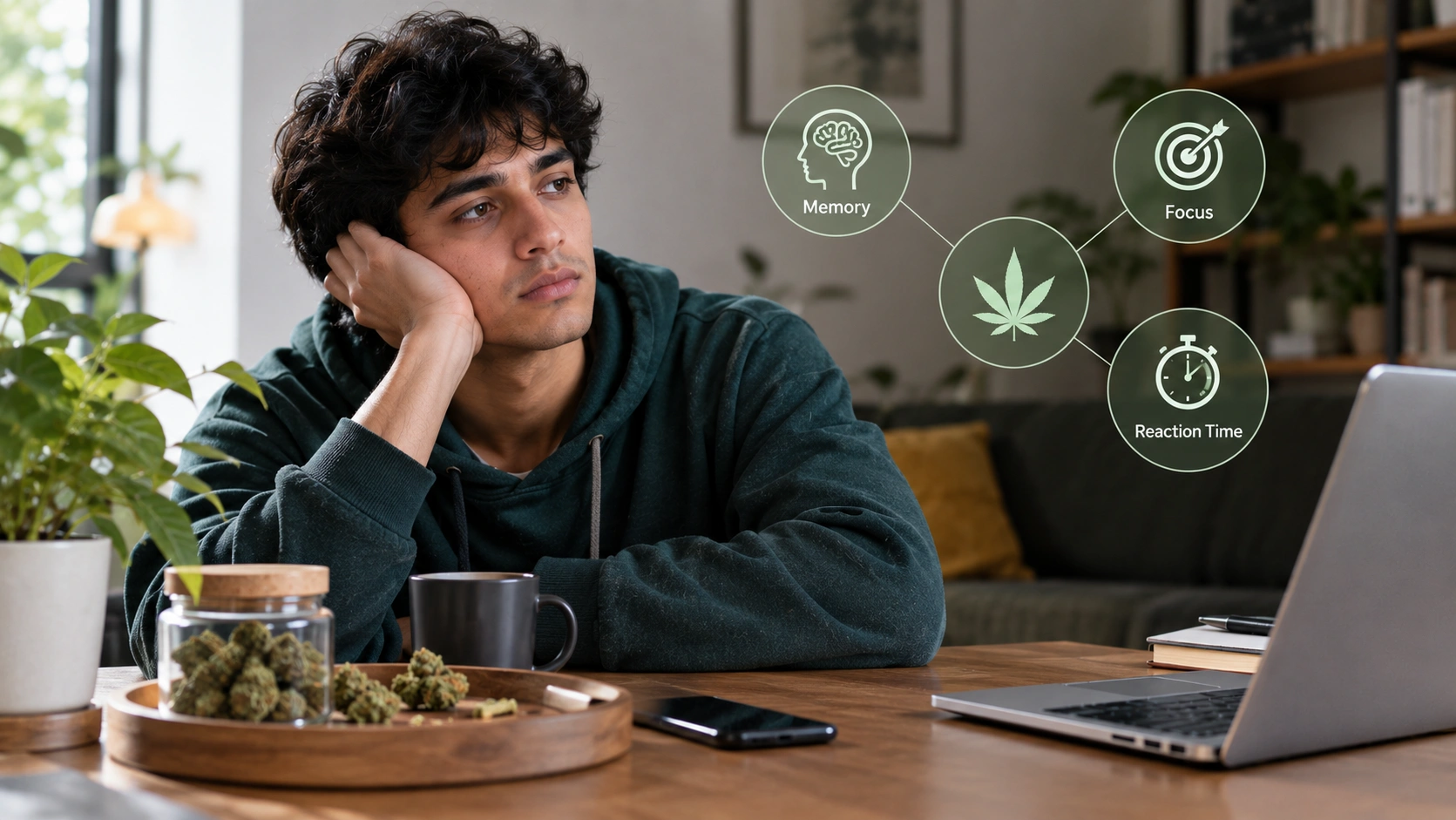
Cannabis can affect brain functions involved in memory, attention, decision-making, coordination and reaction time. The effects can vary depending on factors such as the THC concentration, amount used, frequency of use, age and whether other substances are used at the same time.
Understanding what is happening can help you look at changes in concentration or memory without immediately assuming that something is permanently wrong with your brain.
Does Cannabis Slow Your Thinking?
Yes, cannabis can temporarily affect several cognitive functions, particularly while a person is intoxicated. Recent cannabis use can affect thinking, attention, memory, coordination and the perception of time. THC, the main psychoactive compound in cannabis, is responsible for many of these effects.
This may look like:
- Taking longer to process information
- Losing track of a conversation
- Forgetting what you were about to say
- Finding it harder to concentrate
- Responding more slowly
- Having difficulty making decisions
- Feeling less mentally sharp
The degree of impairment is not identical for everyone. Cannabis products can also vary considerably in THC strength, which can influence the intensity of their effects.
How Does Cannabis Affect Memory and Focus?
Memory and attention depend on coordinated activity across several brain systems. Cannabis directly affects brain functions involved in memory, learning and attention.
Short-term memory
One noticeable effect can be difficulty retaining new information. You may understand what someone is saying but struggle to remember the details a short time later.
This can become especially frustrating during conversations, studying or work that requires you to hold several pieces of information in mind.
Attention and concentration
Cannabis can also affect the ability to maintain attention. Tasks that normally feel straightforward may require more effort, particularly when they involve sustained concentration or multiple steps.
Reaction time and decision-making
Cannabis can slow reaction time and affect decision-making. This is particularly important for activities such as driving, where attention, coordination, perception and rapid responses are essential.
Feeling capable of driving is not the same as being unimpaired. Avoiding driving after using cannabis is an important safety consideration.
What Can Make Cognitive Effects More Noticeable?
The effects of cannabis are influenced by more than simply whether someone uses it.
Factors can include:
- THC concentration
- Amount consumed
- Frequency of use
- Age when cannabis use begins
- Whether alcohol or other substances are used at the same time
- Individual differences in response
Higher THC concentrations can produce stronger effects, and using cannabis alongside alcohol can increase impairment.
Another important factor is the pattern of use. Someone who occasionally notices temporary changes in concentration is in a different situation from someone who repeatedly uses cannabis despite difficulties at work, home, relationships or daily responsibilities.
What If Cannabis Is Affecting Your Everyday Life?
Sometimes the concern is not one episode of forgetfulness. It is a developing pattern.
You might notice that you:
- Regularly struggle to concentrate
- Depend on cannabis to relax or cope
- Keep using it despite problems it creates
- Have difficulty reducing or stopping your use
- Give up activities or responsibilities because of cannabis
- Experience recurring problems with memory or learning
These patterns do not automatically mean that someone has a cannabis use disorder. However, continuing to use cannabis despite physical, psychological, social or occupational problems can be a warning sign that professional assessment may be useful.
It is also important not to assume that every concentration or memory problem is caused by cannabis. Sleep, stress, anxiety, depression, medications, other substances and several other factors can affect cognitive functioning.
Can Cannabis Affect Anxiety and Thinking?
The relationship between cannabis and anxiety is not straightforward.
Some people may use cannabis because they believe it helps them relax. However, cannabis can also cause unpleasant feelings such as anxiety, paranoia or disorientation, particularly in some circumstances.
This can create a difficult cycle.
A person feels anxious, uses cannabis to cope, experiences unpleasant psychological effects, becomes more concerned about their thoughts or behaviour, and then feels the need to use cannabis again to manage that discomfort.
If anxiety is becoming persistent or interfering with daily life, addressing the underlying concern may be more useful than relying on cannabis as the primary coping strategy.
When Should You Consider Professional Support?
Consider speaking with a psychologist if concerns about cannabis are becoming connected with persistent anxiety, avoidance, concentration difficulties or problems in everyday functioning.
Professional support can be particularly relevant if you:
- Feel unable to control your cannabis use
- Keep trying to cut down but struggle to do so
- Experience significant anxiety around your thoughts or behaviour
- Avoid work, social situations or responsibilities
- Continue using cannabis despite negative consequences
- Feel that cannabis has become your main way of managing difficult emotions
Individual therapy can provide a private space to understand patterns of substance use, emotional triggers, anxiety and coping behaviours.
If anxiety is a major part of the problem, anxiety therapy may also help you develop healthier ways of responding to anxious thoughts and uncomfortable emotions.
What I Observe as a Psychologist
As a psychologist, I believe it is important to look beyond the question, “Is cannabis bad for my brain?”
A more useful question can sometimes be, “What role is cannabis playing in my life right now?”
For some people, the concern may be temporary changes in concentration after use. For others, cannabis may gradually become connected with stress management, emotional avoidance or difficulty facing uncomfortable situations.
I also encourage people not to interpret one episode of forgetfulness as proof that their brain is permanently damaged. Cognitive experiences are influenced by many factors, and a person’s overall pattern matters.
When someone is worried about their memory, focus or thinking, understanding the context is often more helpful than judging themselves for what they are experiencing.
Tanu Choksi (Psychologist)
What Can You Practise?
If you are concerned about how cannabis may be affecting your thinking, start by observing rather than judging.
You can:
- Notice whether concentration changes occur after cannabis use.
- Pay attention to patterns in sleep, stress and mood.
- Avoid driving or operating machinery when impaired.
- Avoid combining cannabis with alcohol or other substances.
- Keep track of situations where memory or focus becomes difficult.
- Reflect on whether you are using cannabis to avoid uncomfortable emotions.
- Speak with a mental health professional if the pattern is becoming difficult to manage.
The goal is not to become fearful of every change in memory or concentration. It is to become more aware of what may be contributing to those changes.
Key Takeaways
- Cannabis can affect memory, attention, thinking, decision-making and reaction time.
- Short-term cognitive effects can occur after recent cannabis use.
- The effects can vary depending on THC concentration, amount used, frequency and other factors.
- Cannabis can impair skills needed for safe driving, including reaction time and decision-making.
- Anxiety and unpleasant psychological experiences can occur in some people who use cannabis.
- Persistent problems with cannabis use, anxiety or everyday functioning may warrant professional support.
- Individual therapy can help explore emotional triggers, coping patterns and behaviours without judgement.
Your Thinking Does Not Define You
Noticing changes in memory, focus or thinking can be unsettling, but it does not mean you need to label yourself based on one experience.
What matters is understanding the pattern, considering the factors that may be contributing to it, and recognising when additional support could be useful.
If cannabis use is becoming connected with anxiety, emotional distress, avoidance or difficulties in everyday life, speaking with a psychologist can help you explore what is happening and develop healthier coping strategies.
Looking for Individual Therapy in Mumbai?
If you are struggling with anxiety, emotional concerns, substance-related patterns or difficulties that are affecting your everyday life, professional support can provide a structured and non-judgemental space to understand what you are experiencing.
Tanu Choksi provides psychological support tailored to individual concerns, with therapy focused on understanding patterns and developing healthier ways of coping.
Frequently Asked Questions
Q1. Can cannabis affect your memory?
A. Yes. Cannabis can affect brain functions involved in memory and learning, particularly following recent use. The extent and duration of effects can vary between individuals.
Q2. Does cannabis slow reaction time?
A. Cannabis can slow reaction time and affect decision-making and coordination. This is one reason driving after cannabis use can be unsafe.
Q3. Can cannabis affect concentration?
A. Yes. Recent cannabis use can affect attention and concentration, making some tasks more difficult while a person is experiencing its effects.
Q4. Can cannabis make anxiety worse?
A. Cannabis can cause anxiety, paranoia or disorientation in some people. The relationship between cannabis use and mental health is complex, so persistent anxiety should be discussed with a qualified mental health professional.
Q5. Can therapy help if cannabis is affecting my everyday life?
A. Yes. Individual therapy can provide a space to explore cannabis use, emotional triggers, anxiety, coping strategies and behaviours that may be affecting everyday functioning. A psychologist can help determine what kind of support may be appropriate.