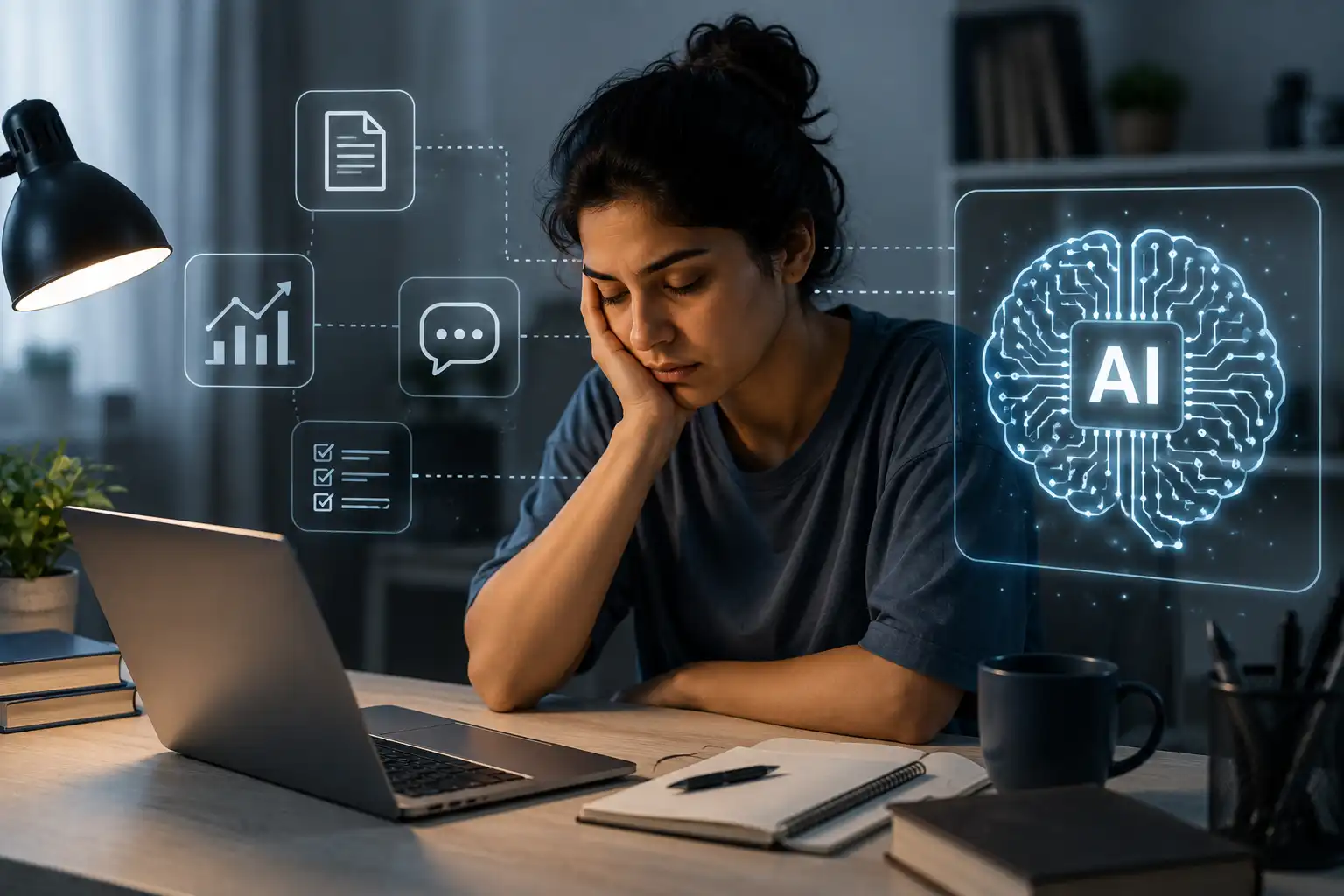
Imagine being asked to write an email without an AI assistant. You know what you want to say, but suddenly the blank screen feels strangely intimidating.
Or perhaps you used to remember phone numbers, navigate unfamiliar places or work through a difficult problem yourself. Now, there is an app, search engine or AI tool ready to do it for you.
These changes can be convenient. But they raise an interesting question: when technology repeatedly does something for us, do we become less capable of doing it ourselves?
This concern is increasingly described as AI de-skilling. It does not necessarily mean that artificial intelligence is making people less intelligent. Instead, it raises questions about what happens when we repeatedly outsource parts of thinking, remembering, writing, analysing or decision-making to technology.
What Is AI De-Skilling?

AI de-skilling refers to the gradual reduction of opportunities to practise or maintain certain human skills when artificial intelligence regularly performs those tasks for us.
The concept is closely related to cognitive offloading, where people use external tools to reduce the mental effort required for a task.
Cognitive offloading itself is not new. We have relied on calculators, maps, spellcheckers, calendars and search engines for years. The difference with generative AI is the breadth of tasks it can perform, including writing, summarising, coding, brainstorming, research and decision support.
The important question is therefore not whether using AI is inherently harmful.
It is which skills we continue to practise, which ones we hand over to AI, and whether we still know how to evaluate the output.
How Can AI De-Skilling Happen?
Skills generally become stronger through practice, feedback and repeated use. When technology consistently performs a task instead, our opportunities to practise that task can decrease.
For example, a student who uses AI to produce every first draft may spend less time practising how to structure an argument. An employee who automatically delegates every analytical task to an AI system may get fewer opportunities to work through uncertainty independently.
This is sometimes called automation bias, where people may place too much trust in automated recommendations or accept an output because it appears authoritative.
Research into automation and cognitive offloading suggests that external tools can reduce immediate mental effort, but reliance on them can also affect how much information people retain or how actively they engage with a task.
That does not mean using an AI tool automatically causes a loss of skill. The effect depends on how the tool is used.
Which Human Skills Could Be Affected?
Not every skill is equally vulnerable to technological assistance.
Critical thinking and judgement
If someone accepts AI-generated conclusions without checking the reasoning or evidence behind them, they may practise independent evaluation less often.
Writing and communication
Using AI to generate every message can save time, but writing is also a way of organising thoughts. Removing too much of that process may reduce opportunities to develop clarity, tone and personal expression.
Memory and recall
External tools can make remembering information less necessary. This is useful for everyday efficiency, but it also means that people may retain less information when they routinely rely on external retrieval.
Problem-solving
Struggling with a problem is often part of learning. If an AI tool immediately supplies an answer, a person may miss the opportunity to work through uncertainty, make mistakes and discover a solution independently.
Decision-making
AI can provide useful information, but decisions often involve values, context, relationships and consequences that cannot simply be delegated to a system.
Is AI De-Skilling Always a Bad Thing?
No.
Technology has always changed the skills people need. We do not expect people to perform calculations manually when a calculator can do them accurately. Similarly, using AI for repetitive tasks can free people to spend more time on creative, interpersonal or strategic work.
The issue is over-reliance rather than assistance itself.
A useful distinction is:
Using AI to extend a skill means you remain involved in the thinking.
Using AI to replace the skill entirely means you increasingly stop practising it.
For example, asking AI to critique your draft can encourage learning. Asking it to write everything and submitting the result without reviewing it provides a very different learning experience.
What Happens When We Stop Practising Certain Skills?
The psychological concern is not simply that someone might forget how to perform a task.
It is also about confidence.
When a person repeatedly relies on technology, they may begin to doubt their own ability to work independently. A task that once felt manageable can start feeling unnecessarily difficult without technological assistance.
This can create a cycle:
Less practice → lower confidence → greater reliance → even less practice.
At the same time, constant digital assistance can contribute to another form of strain. People may feel pressure to respond faster, produce more and remain constantly productive because technological tools make it possible.
The result can be a complicated relationship with technology: it reduces effort in some areas while increasing expectations in others.
How Can We Use AI Without Losing Our Own Skills?
The goal does not have to be avoiding AI. Instead, it can be about using it deliberately.
Do some tasks yourself first.
Before asking AI for an answer, try to form your own view. This gives you something to compare against the output.
Use AI as a critic, not only a creator.
Ask it to identify gaps, challenge an argument or suggest alternative perspectives rather than doing the entire task for you.
Keep practising essential skills.s
Continue writing, reading deeply, solving problems and making decisions without technological assistance when those skills matter to your work or personal life.
Check important outputs
AI systems can produce incorrect or misleading information. Human judgement remains essential, particularly when decisions have significant consequences.
Protect periods of uninterrupted thinking.ng
Not every moment needs optimisation. Allowing yourself time to think, struggle with a problem or formulate an idea independently is also valuable.
When Does Technology Dependence Become a Concern?
Using technology frequently is not automatically a psychological problem.
It may become worth examining when you notice that you:
- Feel unable to complete familiar tasks without assistance
- Avoid thinking through difficult problems yourself
- Automatically accept AI-generated information
- Feel unusually anxious when technological help is unavailable
- Have stopped practising skills that are important to you
- Depend on digital tools to make decisions you previously handled independently
The key question is not “How much AI do I use?”
It is “What am I no longer practising because AI does it for me?”
What I Observe as a Psychologist
In my work, I often notice that people’s relationship with technology is influenced by more than convenience.
Some people turn to digital tools because they feel they must be faster, more productive or more capable than they realistically can be. Others use technology because making a mistake themselves feels uncomfortable. Having an answer immediately can temporarily remove that uncertainty.
I have also observed that people can become surprisingly self-critical when they struggle with something that technology can accomplish instantly. They may think, “Why can’t I do this when a tool can do it in seconds?”
But human thinking was never designed to compete with machines on speed alone.
I believe it is more useful to ask what we want technology to help us with and what we still want to remain our own. A person can use AI extensively and still maintain strong judgement, curiosity and independent thinking if they remain actively engaged with the process.
For me, the concern begins when convenience quietly turns into avoidance, and assistance gradually becomes dependence.
The goal is not to reject technology. It is to remain psychologically and intellectually engaged while using it.
- Tanu Choksi (Psychologist)
Can Stress Make Us More Dependent on Technology?
It can be easier to rely heavily on shortcuts when we are overwhelmed, tired or under pressure.
When demands accumulate, people naturally look for ways to reduce cognitive load. AI can be useful in that situation, particularly for repetitive or administrative work.
However, if someone is already experiencing persistent stress, constantly trying to work faster may not address the underlying problem.
Stress management therapy can provide a space to understand patterns of overwhelm, pressure, perfectionism and coping. Rather than simply teaching someone to become more productive, therapy can help explore what is driving the pressure in the first place.
Tanu Choksi’s practice offers individual therapy in a confidential setting, where people can explore emotional concerns, behavioural patterns and healthier coping mechanisms.
When Might Individual Therapy Be Helpful?
Individual therapy may be worth considering when technology-related stress is part of a broader pattern involving anxiety, overwhelm, self-doubt, difficulty switching off or persistent pressure to perform.
The purpose is not to label normal technology use as a problem. Instead, therapy can provide an opportunity to understand how technology fits into a person’s emotional and behavioural patterns and whether those patterns are helping or creating additional strain.
Key Takeaways About AI De-Skilling
- AI de-skilling refers to the potential loss or weakening of skills through reduced opportunities to practise them.
- Using AI does not automatically cause cognitive decline or loss of intelligence.
- The effect depends largely on whether AI supplements or replaces human thinking.
- Critical thinking, writing, problem-solving, judgement and decision-making can all be affected when practice is consistently outsourced.
- Technology can reduce cognitive effort while also creating pressure to work faster and do more.
- Maintaining independent practice can help preserve important skills.
- Persistent technology-related stress or dependence may be worth exploring with professional support.
Keeping the Human Skill in the Loop
AI is unlikely to disappear from everyday work, education or communication. The more useful question is not whether we should use it, but how we use it without giving away every opportunity to think for ourselves.
There is nothing wrong with accepting help. The concern begins when we stop knowing what we can do without it.
Perhaps the healthiest relationship with AI is not one in which humans compete with technology or avoid it completely. It is one in which we remain capable of questioning, creating, deciding and thinking independently, while using technology where it genuinely adds value.
Need Support With Stress or Feeling Overwhelmed?
If pressure to perform, constant digital demands or difficulty switching off is affecting your emotional wellbeing, individual therapy can offer a confidential space to understand these patterns and develop healthier ways of coping. Tanu Choksi provides individual therapy and support for a range of emotional and behavioural concerns.
Frequently Asked Questions
Q1. What is AI de-skilling?
A. AI de-skilling describes the potential weakening of skills when people regularly rely on artificial intelligence to perform tasks they previously practised themselves. It does not mean AI automatically makes people less intelligent. The concern is that reduced practice may affect specific abilities over time.
Q2. Can using AI reduce critical thinking skills?
A. Using AI does not automatically reduce critical thinking. The risk is greater when people accept AI-generated answers without questioning, verifying or analysing them. Using AI to challenge ideas, compare perspectives or support research can still involve active human judgement.
Q3. How can I prevent AI from affecting my skills?
A. Keep practising important skills independently. Try solving a problem or drafting an idea before asking AI for assistance, use AI for feedback rather than complete replacement where appropriate, and continue checking important information yourself.
Q4. Can technology use contribute to stress?
A. Technology can sometimes contribute to stress when it creates expectations of constant availability, faster responses or higher productivity. However, technology affects people differently. If digital demands are contributing to persistent overwhelm, examining the underlying stress pattern may be helpful.
Q5. Can individual therapy help with technology-related stress?
A. Individual therapy may help when technology-related pressure is connected with anxiety, overwhelm, perfectionism, self-doubt or difficulty switching off. Therapy can provide a confidential space to understand these patterns and explore healthier ways of managing stress and everyday demands.