
Most parents describe it the same way. There was a child who talked to them. Then, somewhere around thirteen or fourteen, that child stopped. It didn’t happen all at once. It happened gradually. Shorter answers. More time behind a closed door. A look that said “you wouldn’t understand” before anything was even said.
What follows is usually a mixture of hurt, confusion, and a low-level worry that something is wrong. Either with the teenager, or with the relationship, or with something the parent did.
I want to address that worry directly, because it shapes how parents respond and how they respond matters more than most of them realise.
This is not rejection. It’s developmental work.
The single most important reframe I offer parents is this: the distance your teenager is putting between you is not about you. It is about them, in the most literal developmental sense.
Adolescence is the period in which a person has to figure out who they are separately from their family. Psychologists call this individuation: the process of forming an identity that is genuinely the teenager’s own, not just a reflection of their parents’ values, expectations, or personality. For that work to happen, some psychological distance from parents is not just normal. It is necessary.
A teenager who never begins to develop greater independence may sometimes struggle with individuation later in life, although every adolescent’s journey looks different. In some cases, this can make the transition into adulthood more challenging.
The distance, in other words, is a sign that something is going right even when it feels like everything is going wrong.
What is actually happening in a teenage brain
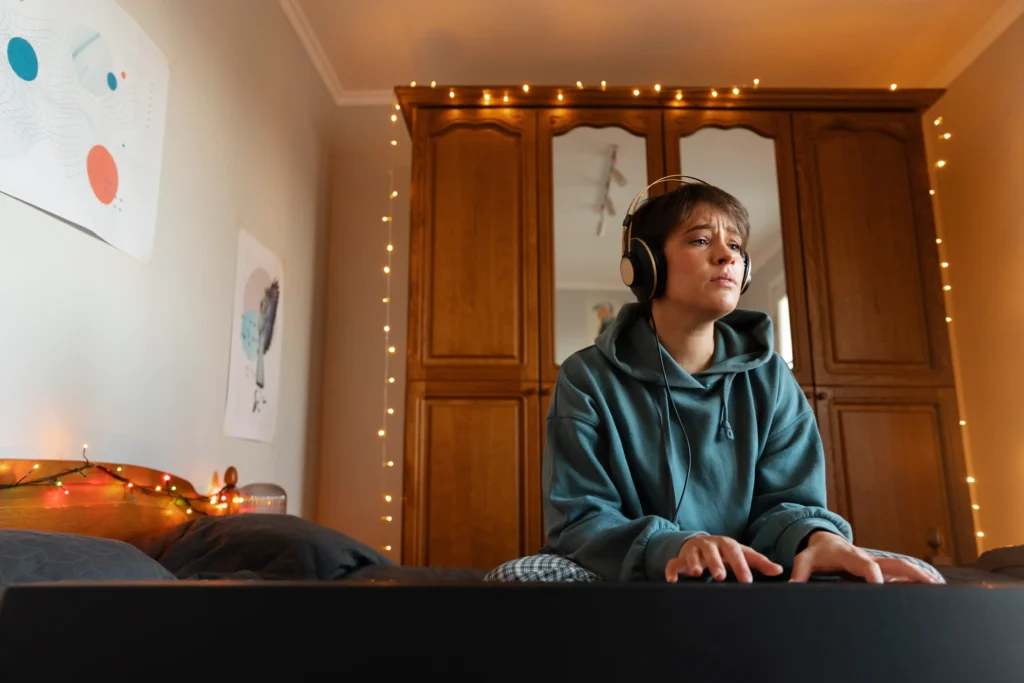
The withdrawal parents experience is not purely psychological. There is a neurological basis for it that is worth understanding, because it changes how the behaviour reads.
The teenage brain is in the middle of a significant reorganisation. The limbic system, the part responsible for emotion, reward, and social sensitivity, is highly active during adolescence. The prefrontal cortex, which handles impulse control, forward planning, and the ability to see other people’s perspectives clearly, does not fully mature and continues developing into the mid-twenties.
What this means practically is that teenagers feel things intensely and often struggle to regulate or explain what they’re feeling. The grunt at the dinner table, the eye-roll, the “I’m fine” that clearly means something else. These are not always deliberate choices. Sometimes they reflect a nervous system that is genuinely overwhelmed and doesn’t yet have the tools to process that out loud.
This does not mean the behaviour gets a free pass. It means the interpretation of it matters. A teenager who goes silent after school is more likely exhausted from a day of social navigation than indifferent to their family.
The peer relationship shift is real, and it’s supposed to happen
Something that parents find particularly hard is watching their teenager prioritise friendships over family in ways that feel pointed.
During adolescence, the attachment system which in childhood is oriented primarily toward parents many attachment needs begin to shift toward peers. This is not a rejection of family. It is a developmental rehearsal for the adult relationships the teenager will eventually need to sustain independently. They are practising intimacy, loyalty, conflict, and repair with people their own age, in a context where the stakes feel lower than they do at home.
The catch is that this shift can feel, from a parent’s side, like being demoted. And the feelings that come with that hurt, jealousy, a sense of being shut out are completely understandable. What I find is that parents who can hold those feelings without acting on them tend to keep the door open in ways that matter later. Parents who respond to the shift with increased pressure or hurt withdrawal of their own tend to accelerate the very distance they’re trying to close.
When distance becomes something to pay attention to
Most teenage withdrawal is developmental. Some of it is not, and it is worth being honest about the difference.
The things that warrant attention are changes in pattern rather than the withdrawal itself. A teenager who has always been fairly social and suddenly stops seeing anyone. One who was managing school reasonably and begins missing it regularly. Significant changes in sleep, appetite, or weight that persist beyond a few weeks. Signs of self-harm, or talk-even indirect talk-about not wanting to be here.
Mood and irritability on their own are not reliable indicators. Most teenagers are irritable fairly often. What you are looking for is a shift from the teenager’s own baseline, not a comparison to some imagined calm adolescent norm.
If you are noticing those kinds of changes, the question is not whether to take them seriously. It is how to create the conditions in which your teenager can let you in enough to get help.
How parents accidentally make it worse
I say this carefully, because most parents doing the things I’m about to describe are doing them out of genuine love and worry. That does not make them less counterproductive.
Interrogating rather than being available. “How was your day / who did you talk to / why are you in a bad mood / what happened” delivered in quick succession is often experienced by most teenagers as surveillance, not interest. It closes down rather than opens up.
Making their withdrawal about your feelings. “You never talk to me anymore, I feel like I’m losing you” may be entirely true, but it hands the teenager an emotional problem, their parent’s distress on top of whatever they are already carrying. They then either have to manage your feelings, which is not their job, or they learn that being honest with you produces more weight rather than less.
Treating every closed door as a problem to be solved. Sometimes teenagers need to be alone. An adult who needed two hours of quiet after a hard day would not expect to justify it. Teenagers need the same.
None of this means stepping back entirely. It means the quality of availability matters more than the quantity of contact.
What actually keeps the connection open
In my experience, the parents who maintain real relationships with their teenagers through this period tend to share one quality: they made themselves worth talking to before the withdrawal started, and they stay that way through it.
What that looks like in practice varies. It might be a parent who watches something the teenager is interested in without commenting on whether they find it worthwhile. One who shares something about their own day or week that is actually honest, not a teaching moment in disguise. One who can sit in the car without filling every silence.
Teenagers talk when they are ready and when they believe the response they get will not make things worse. They learn that through repeated small experiences the times they said something and it was received without judgment, without immediate advice, without anxiety. Those experiences accumulate. They are the reason a teenager at sixteen will walk into the kitchen at eleven at night and say something they’ve been carrying for weeks.
You cannot engineer that moment. You can make yourself the kind of person it happens with.
What I have observed as a psychologist
Parents come to me expecting me to tell them what to do differently. Most of the time, the more useful conversation is about what they are feeling because what they are feeling is driving what they do more than they realise.
The parents I find hardest to work with are not the ones who are struggling. They are the ones who have decided that the distance means something definitive: that they have failed, that the relationship is broken, that it is too late. That conclusion tends to produce exactly the behaviour that confirms withdrawal, over-control, or a kind of performed casualness that teenagers see through immediately.
In my experience more consistently true is that the relationship is rarely as damaged as it appears during the worst of adolescence. Many teenagers who seem unreachable at fifteen, at twenty-two, describe their parents as people they actually want to talk to. What changed was not usually a dramatic intervention. It was time, and a parent who stayed present without making presence a demand.
I also want to name something I see in family therapy specifically: the teenager’s distance is often a communication, not an absence of one. What they are communicating varies, sometimes it is “I need space,” sometimes it is “I don’t feel safe bringing this to you yet,” sometimes it is “I don’t have words for what I’m going through.” Family therapy is often most useful not because it fixes the teenager, but because it helps parents hear what the distance is actually saying.
Final thoughts
Teenage issues rarely resolve through strategies. They resolve through relationships, a slow, imperfect, often frustrating relationship that asks parents to stay available without making their availability a form of pressure.
The distance is real. So is the fact that most teenagers, given time and a parent who doesn’t panic, find their way back.
If you are finding it hard to reach your teenager and the usual approaches aren’t working, or if you are worried that what you’re seeing goes beyond typical adolescence, speaking with a psychologist can help you work out what’s actually happening and what might help.
Take the first step. Reach out to discuss your concerns, Sometimes the most useful starting point is a conversation with a parent alone, before anything else.
Follow Tanu Choksi on Instagram, LinkedIn, and Facebook for expert insights on therapy and self-understanding.
FAQs
Q1: Is it normal for teenagers to suddenly become distant from their parents?
A: Yes, A little emotional distance is normal as teens grow in independence. But abrupt or persistent changes in mood, behaviour or daily routine may require attention.
Q2: How do I get my teenager to open up to me?
A: Focus on being consistently available, listening without judgment and not pressuring. Trust is built in the small things of everyday interaction.
Q3: My teenager seems fine with everyone else but barely speaks to me. Why?
A: It can be normal. For many teenagers, home is the safest place to express their feelings. If the relationship is steadily becoming tense or hostile, it might be worth looking into.
Q4: When should I consider family therapy for teenager issues?
A: Family therapy can be a good choice if communication has broken down, conflicts keep coming up, or your family feels stuck after making efforts to improve things.
Q5: Could my teenager’s distance be depression rather than normal adolescence?
A: Possibly. If withdrawal is associated with persistent changes in mood, sleep, appetite, or loss of interest in activities, you should see a psychologist or General Physician.